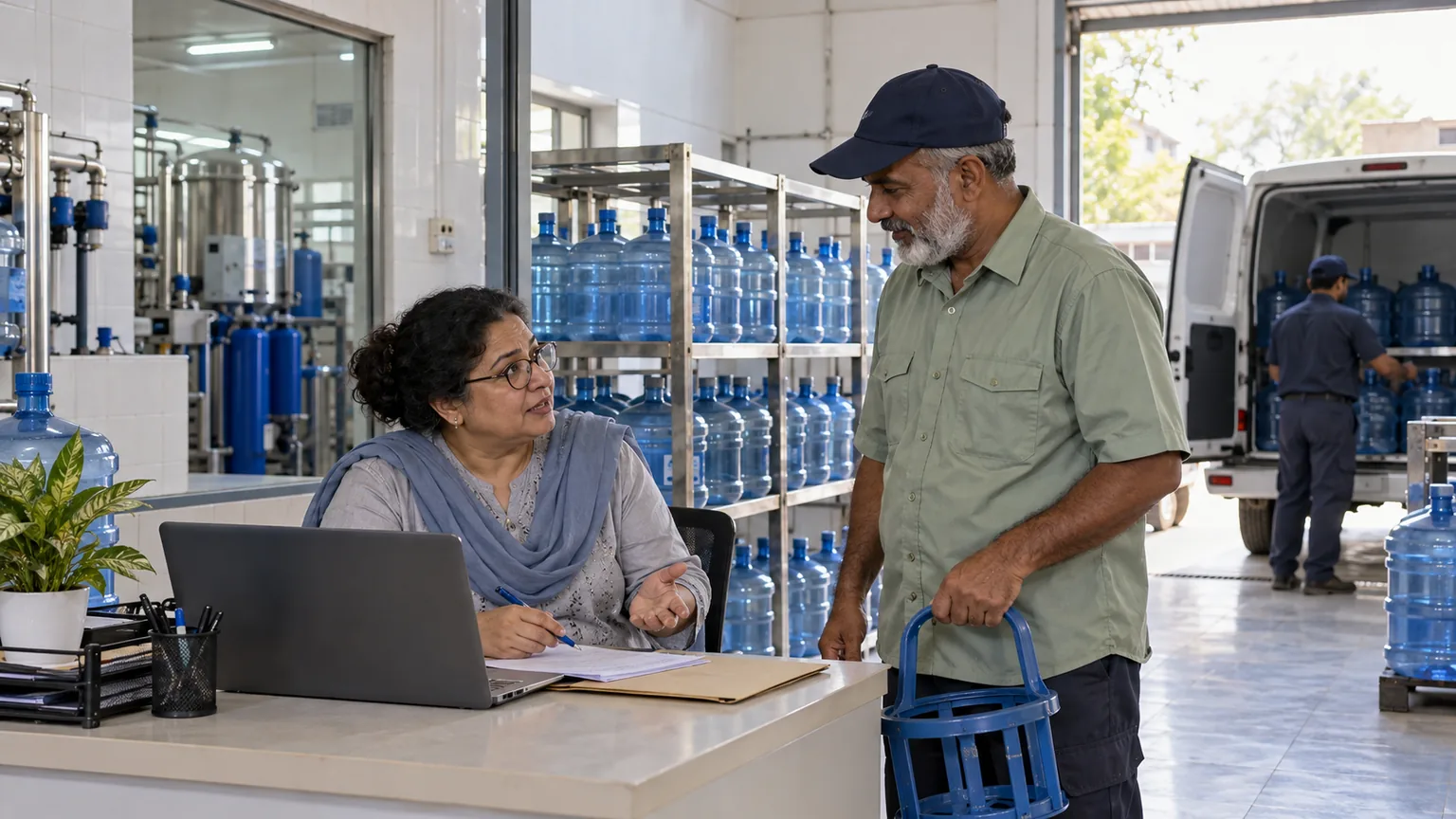
Recurring water deliveries create two records to keep straight: what the customer received and which returnable bottles came back. ALGONLP can assess water delivery software that connects schedules, rider rounds, bottle movements, deposits, invoices and complaints. A practical first scope focuses on a few routes and the records your office and riders can maintain reliably.
See delivered and returned bottles separately.
Reconcile rider cash against each round.
Keep missed deliveries and complaints assigned.
Illustrative workflow.
Workflow comparison
Before and after: how the workflow could change
Illustrative comparisons for a scoped implementation. The proposed workflow depends on agreed processes, supported integrations and staff use.
Shows which bottle movements created the outstanding quantity.
Today
Delivered bottles and empty returns are combined into an informal customer balance.
Proposed workflow
A proposed bottle ledger records full deliveries and empty returns separately.
How it works
Reconcile opening quantities first, then link each rider exchange to its customer and round. Office staff approve corrections.
Gives the office a specific list of differences to resolve.
Today
The rider’s cash handover cannot be matched confidently to the day’s deliveries.
Proposed workflow
A round reconciliation compares delivery payments, returned stock and handed-over cash.
How it works
Record cash and invoice customers distinctly; review unmatched amounts with the rider before finance adjusts balances.
Makes pending delivery commitments visible to the office and rider team.
Today
An extra WhatsApp order or missed recurring delivery is remembered only by one staff member.
Proposed workflow
Approved extra requests and recurring orders enter an owned route queue.
How it works
Staff confirm customer, quantity and route, while missed service remains open until rescheduled or resolved.
Illustrative example
A practical end-to-end example
Illustrative example: a regular office requests extra bottles for its next round. Staff approve the request and update the route. The rider records full bottles delivered, empties returned and the monthly-invoice reference. On return, the office checks remaining stock and cash from other customers; any bottle difference stays assigned until it is explained.
Where repeat deliveries become hard to reconcile
Regular orders and one-off requests arrive through separate calls, messages and notebooks.
Delivered and returned bottles are recorded without a dependable customer-level opening balance.
Deposits, cash deliveries and monthly office invoices follow different records and approval habits.
Complaints and missed rounds have no visible owner or confirmed resolution.
Run a traceable delivery round
Set up the customer
Record the authorised delivery address, schedule, billing arrangement and agreed bottle/deposit opening position.
Prepare the route
Combine recurring deliveries and approved extra requests. Show quantities, access instructions and missed-service exceptions.
Load and hand over
Record the rider’s issued bottles and assigned route, with responsibility for stock and cash clearly defined.
Record the doorstep exchange
Capture delivered and returned quantities separately, plus accepted payment or an invoice reference.
Reconcile the round
Compare remaining bottles, returns and cash with recorded deliveries. Office staff review discrepancies before adjusting balances.
Handle the next service
Assign complaints, rescheduling and account follow-up. Keep plant batch or maintenance records separately where the agreed process needs them.
Scope the delivery operation first
The project can include a customer and subscription register, route lists, rider interface, bottle ledger, deposits, monthly billing and a complaint queue. Urdu labels and intermittent-connectivity handling should be tested with the actual rider team.
Branch stock, plant output, batch references or test-document storage can be added where required. Quality records are operational evidence; they do not turn delivery software into water-quality certification.
AI prepares requests; staff confirm the service
AI may structure authorised Urdu or English messages into draft delivery requests and classify complaints. Staff verify customer, quantity, route and billing terms. Consumption-based reminders need reliable history and appropriate customer permission. AI must not infer drinking-water safety or change bottle deposits and cash balances without the agreed review.
Is this a useful fit for your business?
A good fit is a supplier with several recurring routes, branches or a difficult connection between bottle tracking and billing.
A counter-only refill shop or simple delivery business may be served by existing vertical software. A custom project needs a specific gap and a reconciled opening bottle position.
Include cash and monthly customers, empty-bottle returns, an extra order and a missed delivery.
Expand after reconciliation
Train office and rider teams, resolve exceptions and add routes using agreed operating checks.
Agree the first release
Scope, migration and ongoing operation
What the agreed scope can include
Recurring requests and route lists
Bottle, deposit and billing records
Round reconciliation and complaint tasks
What needs separate scoping
Water-quality certification, laboratory decisions and a full plant-production system are outside the initial delivery scope.
Data migration
Confirm customer bottle quantities, deposits, outstanding balances, routes and recurring billing rules before pilot rounds.
Training and ongoing support
Train office and riders on doorstep exchanges, missed-service status and cash or stock differences. Agree support hours, issue ownership, backups, recovery checks and change-request terms before rollout.
Useful answers
Questions and answers
How do we record bottle returns and deposits?
Keep bottle movements and money movements as separate linked records. Agree opening quantities, deposit policy and who may approve corrections.
Can households and office customers use different billing?
Yes, the scope can distinguish payment on delivery from periodic invoicing. Finance verifies rates, due dates, adjustments and receipt matching.
Will the rider app work in Urdu or offline?
Those are requirements to assess and test. Offline use needs clear sync and duplicate rules; language labels must make sense to your riders.
Does the software prove our water is safe?
No. Any stored batch or test record must reflect your approved quality process and actual evidence. Qualified staff remain responsible for quality decisions.
What determines the project cost?
Rider and branch count, bottle/deposit rules, billing arrangements, offline needs and existing accounts connections drive the estimate. Plant records and additional integrations are separately scoped.
When could we go live?
We set a phased schedule after discovery and access checks, rather than promise a date before scope is known. A rollout date depends on trustworthy opening bottle positions and reconciled pilot rounds across cash and invoice customers. Start with the agreed pilot and expand after sign-off.
Discuss a focused first step
Show us one delivery round
Describe your routes, bottle-return process and billing arrangements. Use a redacted route sheet or balance example to identify a practical starting scope.